The images here were collaged, sketched, folded, and embroidered into an 8.5 x 11 sheet of printer paper; it is both “every day” and so much more—
these pages tell my story as a Taiwanese American from Bozeman, Montana.


from
I have lived on Sheridan Avenue my whole life. “Where am I from?” I was born here. I felt like a temporary body in a place that I had always been from.
I walk by my old best friend’s house; they moved out many years ago. If the people who live there now saw me, what would they think? Oh! new people in the neighborhood.
“Welcome to Booozeeman!” Their fingers pulled their eyes in an upward slant. I wasn’t sure if I felt humiliated for my hometown or enraged that they had just shouted these words in a mocking accent to someone who most likely had been in Bozeman longer than they had. This is home.
Bozeman, Montana is a paradise. On my neighborhood walk, I see snowy deep blue mountains pier through the gap between rooftops. In middle school, she asked me if all I ate at home was noodles. I laughed, but I didn’t know what to say, I mean I eat noodles sometimes. Hospitality is harder when people don’t think they are in my home.


part to part
Feeling the warmth on my skin, it’s a different sun than the one I feel in different parts of the world. You can feel the difference in harshness and brightness, all depending on elevation and air quality. In Bozeman, I walk out, and I’m blinded.
Under the same sun, different experiences; my identity has different parts and even more parts based on the eyes I am seen through. To some, I am a foreigner, even sometimes to myself. To others, I am neither native nor foreign. And sometimes, I am just from Bozeman.
Part of who I am is the history I never lived, and for much of my life never knew. Part Taiwanese. Part exiled Chinese. I am part and everything at once. Part American. Part Asian. Asian American. Part memories lived and part fragments not my own. Part in the places my family lives, where I live, and where I lived. When I came to the American south for college I was Asian American under the same sun, but it was a different feel on the skin. In Durham, the sun feels less piercing.
refusing to live
The mei hua is known for blooming under adversity, a symbol of resilience and perseverance. It became the national flower in Taiwan in 1964.
I was born after both of my grandfathers passed away, and as a young child my maternal grandmother passed away. Memory is fragmented and not always pleasant to share.
Someone once told me that people did not need to know my story. I think it is true; walking down the street, the person who calls out “China!” to address me probably doesn’t need to know exactly who I am. Knowing who I am for myself, that’s different. And, I refuse to make it just for myself; sacrifice bought my story.
Sometimes I have felt stuck, and that’s a privilege born of sacrifice. It sounds strange to not want that privilege. But, the privilege of sacrifice can be paralyzing—unless sacrifice says that all I am is a masterpiece of parts chosen to work together just as each organ is a vital design in the system.


without each part
My grandfather was a refugee running from persecution, an immigrant making home away from home, and an exile never able to return. What he was, or what my father remembers him to be, is a part of me.
He was stopped by physical and political barriers. I am stopped by barriers of distance and language, each driven larger by the wedge of time. My parents were immigrants. My grandfather was an immigrant and exile, growing father away from a land that was no longer his. Still, he sent letters through Hong Kong to his family back in Shandong Province.
Beyond the rigidness of physical barriers, the world is much more dynamic, and eventually distance changes us, it changes what we knew. Sometimes I/he find/found myself/himself much further from what was home then I/he thought I/he would ever be and much closer to another home than I/he thought possible.
Being an exile can be external and internal, something forced upon you or trapping you from within. However, when I think about the national narratives that resulted in geographical dislocation and fragmentation that hides within generations like a scar poorly healed, I think of how much more I am capable of enduring when I choose to see the evidence of the past.
so I travel
I have sat in the car watching unfamiliar familiar scenes pass by and, in that moment, felt right at home. Nothing is still, yet in that moment I feel content. I feel like myself. I think about all the things that are, but aren’t, right now. Maybe I can drive a little car inside myself.

between
Why not sit in the between? It is not as empty or gray as the world would say it is. In fact, the between is vibrant and like capillaries that travel along tissues through the whole body to deliver life-giving oxygen.
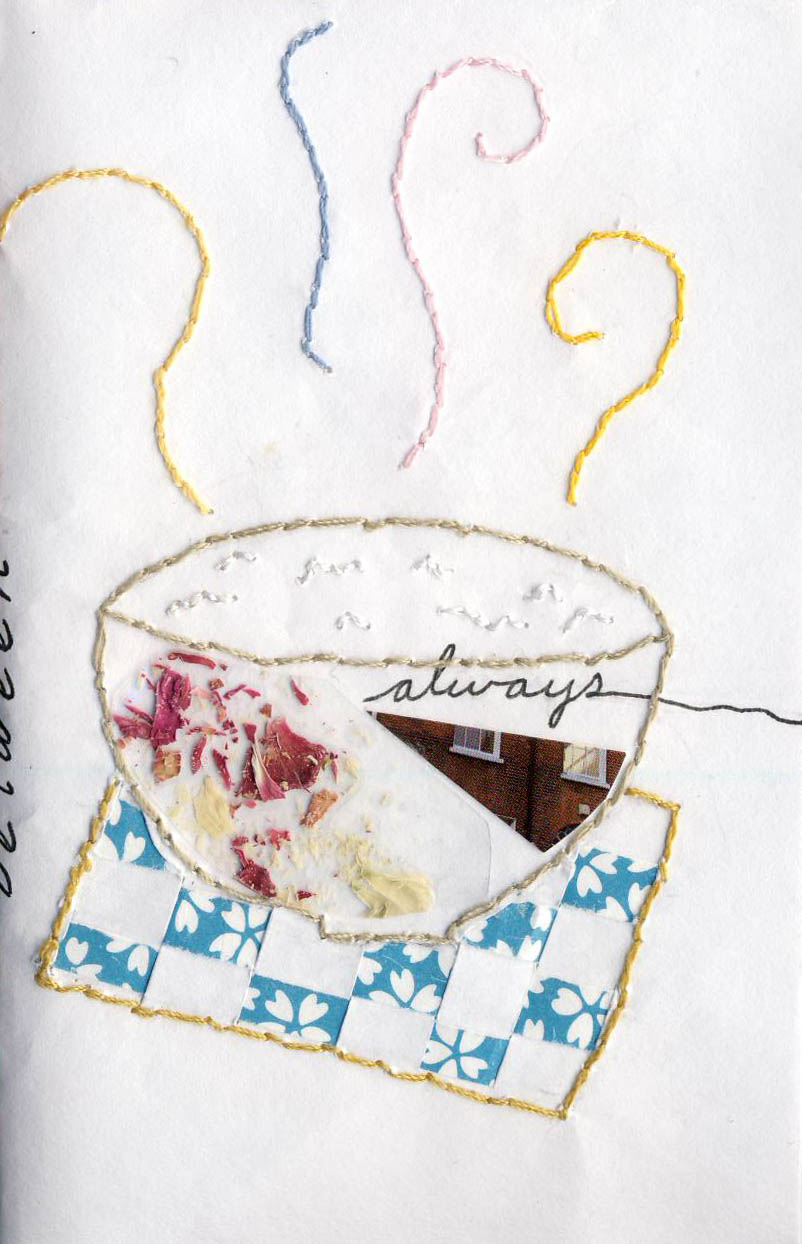
always
I walk outside on Sheridan Avenue, and I’m home. I’m home now, but tomorrow I may be elsewhere, somewhere I don’t feel at home. In those moments I will remember who I am, as a whole made of parts. I’ll tell my story at the table, over food we just made together. I’ll tell them in the way I commute from part to part, refusing to live without each part, traveling between always. I cannot know who I am outside of others, friends, family, memories, and times almost forgotten and unwritten.
“Do you want shi fan?”
Hospitality is just a bit easier when I’m home.
[commuting] home | from | part to part | refusing to live | without each part | so I travel between | always
These are the words spoken in my heart and written in my book.
 [Commuting] Home